What are Research Peptides? A Complete 101 Beginner’s Guide
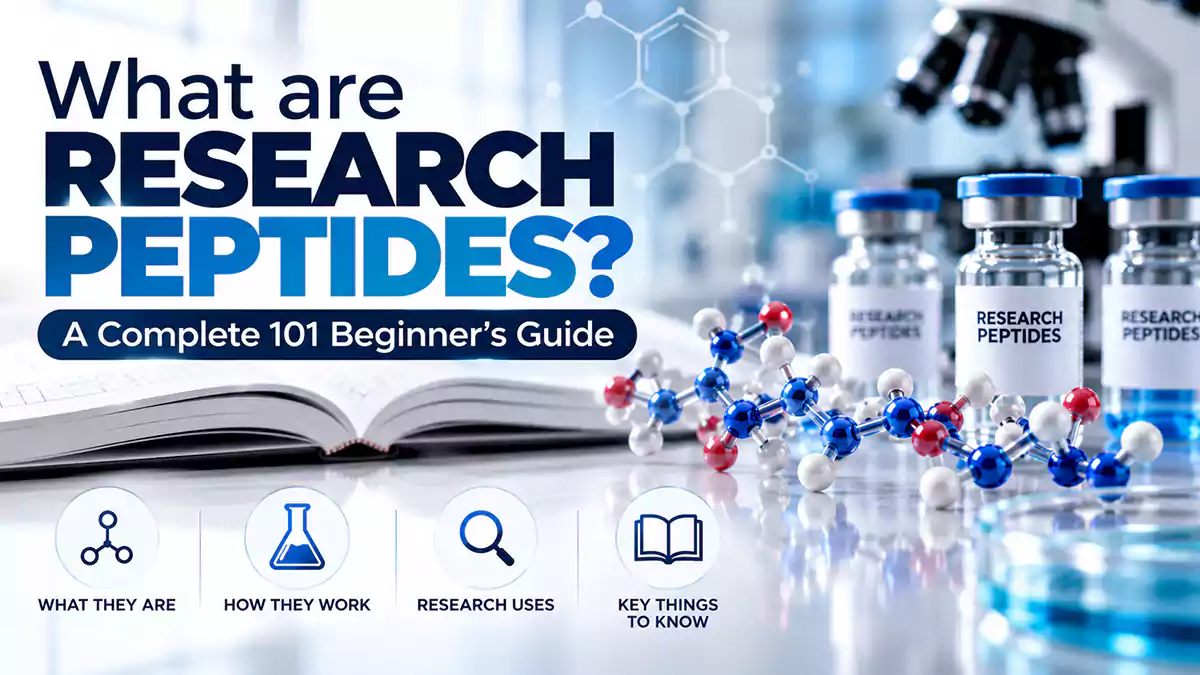
Peptides are small but scientifically important molecules that play diverse roles in biology and chemistry. Scientists study them to understand molecular interactions, cellular communication, and the relationship between amino acid sequences and biochemical behavior.
Research peptides are chains of amino acids used in controlled scientific investigations to study molecular structure, chemical properties, cellular signaling, and biological interactions. They may be naturally derived, chemically synthesized, or modified for specific experimental purposes.
Unlike pharmaceutical products intended for authorized clinical applications, peptides designated exclusively for research are not intended for human or veterinary administration.
This beginner’s guide explains what research peptides are, how peptide bonds form, how peptides differ from proteins, their major classifications, and why synthesis, analytical testing, storage, and responsible research practices matter.
What are Research Peptides?
Research peptides are amino acid-based molecules used as experimental materials in scientific studies.
Researchers investigate their chemical characteristics, molecular structures, stability, and interactions with other molecules. Depending on the research objective, a peptide may serve as a molecular probe, reference material, enzyme substrate, or experimental compound.
The term research peptide describes a peptide’s intended scientific application rather than a unique chemical classification.
Research Peptides Definition in Simple Terms
A research peptide is a molecule used to answer questions about peptide chemistry or biological processes.
For example, scientists may compare two peptide sequences to determine whether a particular amino acid influences molecular stability or receptor binding.
Other experiments may examine how environmental conditions affect peptide degradation.
These investigations generate scientific observations that help researchers understand molecular behavior. They do not automatically establish clinical safety or effectiveness.
Why are Peptides Used in Research?
Peptides provide researchers with useful molecular structures that can be characterized and compared.
Their amino acid sequences can be precisely described, allowing scientists to investigate how individual molecular features influence experimental results.
Common areas of investigation include:
- Molecular recognition and receptor interactions
- Cellular signaling mechanisms
- Protein and enzyme interactions
- Peptide stability and degradation
- Structure-activity relationships
- Analytical method development
The suitability of a peptide depends on the research question, experimental conditions, and the material’s documented characteristics.
The Science Behind Peptides: Amino Acids and Peptide Bonds
Understanding peptide research begins with amino acids.
Amino acids are organic compounds that serve as the building blocks of peptides and proteins. Their arrangement determines many of the chemical characteristics of the resulting molecule.
Amino Acids: The Building Blocks of Peptides
Most naturally occurring proteins are assembled from 20 standard amino acids. However, peptide chemistry also includes nonstandard amino acids and chemically modified residues.
Each amino acid contains a characteristic side chain that contributes to properties such as charge, polarity, solubility, and molecular interactions.
When amino acids connect in a particular order, they create a peptide sequence.
The sequence matters because even a single amino acid substitution can affect the molecule’s structure, stability, or interactions with other chemical compounds.
What is a Peptide Bond?
A peptide bond is a covalent amide linkage that connects amino acid residues.
It forms when the carboxyl group of one amino acid reacts with the amino group of another, producing a bond and releasing water during the condensation reaction.
Repeated peptide bond formation creates a chain with a defined direction, typically described from the N-terminus to the C-terminus.
Peptide bonds help establish the molecule’s backbone, while amino acid side chains influence its physical and chemical behavior.
Understanding this structure is essential for interpreting peptide sequences, molecular characterization, and biochemical research.
Scientific reference: Introduction to Peptide Synthesis, PubMed Central.
Peptides vs. Proteins: What’s the Difference?
Peptides and proteins share the same basic building blocks, but they commonly differ in molecular size, structural organization, and biological complexity.
Peptides generally consist of shorter amino acid chains, while proteins are often larger molecules that fold into complex three-dimensional structures.
A frequently used introductory convention describes peptides as containing approximately 2–50 amino acids and proteins as containing longer chains.
However, this boundary is not universal. Some molecules do not fit neatly into these categories, and terminology may vary across scientific disciplines.
| Feature | Peptides | Proteins |
|---|---|---|
| Basic composition | Amino acids | Amino acids |
| Typical chain length | Generally shorter | Generally longer |
| Molecular structure | Variable complexity | Often complex three-dimensional folding |
| Biological functions | Signaling, recognition, regulation, and others | Enzymatic, structural, transport, and signaling functions |
| Research applications | Sequence analysis and molecular interaction studies | Protein structure, enzyme activity, and functional research |
Both peptides and proteins are important components of biological systems.
What is a Polypeptide?
A polypeptide is a chain of amino acid residues connected by peptide bonds.
The term emphasizes the chain structure rather than a strict numerical length.
A polypeptide may form part of a larger protein, function independently, or require additional folding and association with other chains.
Therefore, peptide and polypeptide are overlapping scientific terms rather than categories separated by a universally accepted number of amino acids.
Endogenous vs. Exogenous Peptides
Peptides can also be described according to their origin.
Endogenous Peptides
Endogenous peptides are produced naturally within a biological system.
Some participate in cellular communication or biochemical regulation, while others arise through the processing or breakdown of larger proteins.
Researchers study endogenous peptides to better understand their structures, interactions, and natural biological roles.
Exogenous Peptides
Exogenous peptides originate outside the biological system being investigated.
Researchers may introduce them into controlled experimental models to examine chemical interactions or measure specific responses.
Exogenous peptides may be synthesized or isolated from natural sources.
Importantly, exogenous does not automatically mean synthetic, and a synthetic peptide may reproduce the sequence of a naturally occurring molecule.
How Do Research Peptides Work at the Cellular Level?
A peptide’s behavior depends on its amino acid sequence, three-dimensional structure, chemical modifications, and surrounding experimental conditions.
Some peptides interact with cellular receptors. Others serve as enzyme substrates, molecular markers, or structural components in biochemical investigations.
Not every peptide functions as a signaling molecule.
Receptor Binding and Cellular Signaling
Cellular receptors are proteins that recognize particular molecular features.
Certain peptide molecules act as ligands, meaning they can bind to compatible receptors under appropriate conditions.
This interaction may influence intracellular biochemical pathways.
Scientists investigate receptor binding to understand molecular recognition, signaling mechanisms, and differences between related peptide sequences.
However, a measurable receptor interaction does not necessarily establish a meaningful biological effect beyond the experimental model.
Why Peptide Sequence Determines Molecular Behavior
The order of amino acids influences molecular properties such as charge, solubility, stability, and structural flexibility.
For example, replacing one amino acid with another can change the way a peptide interacts with its environment.
Researchers examine these differences through structure-activity relationship studies.
Such experiments help identify relationships between molecular structure and measured experimental behavior.
Are Peptides Always Highly Specific?
Some peptides exhibit selective interactions with particular molecular targets.
However, specificity is not a universal characteristic of every peptide.
A molecule may interact with multiple targets, and its observed selectivity may vary according to experimental conditions.
Claims about high precision or minimal off-target interactions require evidence specific to the peptide and assay being discussed.
Major Types of Research Peptides
Research peptides can be categorized according to their molecular characteristics, scientific functions, or production methods.
These classifications may overlap because the same peptide can be studied in different experimental contexts.
1. Signaling Peptides
Signaling peptides are involved in molecular communication within biological systems.
Researchers study their interactions with receptors and the biochemical pathways associated with those interactions.
Investigations may involve receptor selectivity, binding characteristics, and controlled cellular assays.
2. Regulatory Peptides
Regulatory peptides are studied for their relationships with biochemical regulation and cellular processes.
Some occur naturally, while others are synthesized for experimental comparison.
Researchers may examine how sequence modifications influence their interaction with molecular targets.
3. Peptides Studied in Tissue-Response Models
Some peptide sequences are investigated in preclinical models involving cellular responses, extracellular matrix interactions, or molecular signaling.
These experiments can provide information about biological mechanisms under defined conditions.
However, observations from cell-based or animal studies should not be interpreted as evidence of proven clinical healing or therapeutic effectiveness.
4. Antimicrobial Peptides
Antimicrobial peptides are investigated for their interactions with microorganisms and biological membranes.
Many naturally occurring antimicrobial peptides participate in innate immune defense.
Researchers examine molecular charge, sequence variation, membrane interactions, and measurable activity in controlled assays.
5. Synthetic and Modified Peptides
Synthetic peptides are manufactured through chemical synthesis using specified amino acid sequences.
Modified peptides may contain substitutions, terminal modifications, chemical labels, or other structural changes.
These variations help scientists investigate how molecular characteristics influence experimental behavior.
Synthetic and modified peptides are important research tools because their structures can be deliberately defined and compared.
Why Peptides Matter in Modern Scientific Research
Peptides contribute to multiple branches of scientific investigation.
Their defined molecular structures allow researchers to examine biochemical interactions, identify sequence-dependent properties, and develop analytical methods.
Applications in Molecular Biology
In molecular biology, peptides can help scientists investigate interactions between biological molecules.
For example, short peptide fragments may be used to study selected regions of larger proteins.
Researchers can examine whether a defined sequence contributes to binding or recognition under controlled experimental conditions.
Applications in Pharmacology Research
Peptide-related research contributes to the broader understanding of molecular targets and biological signaling.
Scientists may investigate receptor interactions, peptide analogs, and structural modifications.
Some peptide molecules undergo pharmaceutical development, but research findings alone do not establish that a peptide is an approved medicine.
Applications in Oncology and Neuroscience Research
Peptide-based molecular tools are used in investigations involving cellular receptors, biochemical signaling, and molecular recognition.
In oncology and neuroscience, such research can help scientists characterize biological systems and explore mechanisms relevant to the field.
These experimental applications should not be confused with validated diagnostic or therapeutic uses.
Applications in Analytical Chemistry
Peptides are also important in analytical method development.
Scientists may use defined peptide sequences to study chromatographic separation, molecular identification, and measurement techniques.
A well-characterized peptide can serve as a useful material when evaluating an analytical procedure.
How are Synthetic Peptides Produced?
Synthetic peptides are created through chemical methods that assemble amino acids in a defined sequence.
One of the most established techniques is solid-phase peptide synthesis, commonly abbreviated as SPPS.
What is Solid-Phase Peptide Synthesis?
Solid-phase peptide synthesis involves assembling a growing peptide chain while it remains attached to an insoluble solid support.
Amino acids are connected sequentially through controlled chemical reactions.
After assembly, the peptide is separated from the support and prepared for purification and analytical characterization.
American biochemist R. Bruce Merrifield introduced solid-phase peptide synthesis in 1963 and received the 1984 Nobel Prize in Chemistry for developing chemical synthesis methodology on a solid matrix.
His work transformed the field of peptide chemistry by making the preparation of defined sequences more practical.
Scientific references:
- The Nobel Prize in Chemistry 1984, NobelPrize.org
- Fundamental Aspects of SPPS and Green Chemical Peptide Synthesis, Journal of Peptide Science (2025)
Why is Peptide Purification Important?
Chemical synthesis may generate the intended peptide alongside incomplete sequences, modified by-products, or residual chemical impurities.
Purification methods help separate these components.
High-performance liquid chromatography is commonly used in peptide purification and analytical evaluation.
Following purification, additional testing may be required to establish molecular identity and characterize relevant impurities.
No single analytical result necessarily confirms every property of a peptide preparation.
How is Research Peptide Quality Evaluated?
Research quality evaluation involves determining whether a material meets the specifications relevant to its intended experimental application.
Common considerations include molecular identity, purity, impurity characteristics, and batch traceability.
Analytical results must be interpreted according to the methods used.
HPLC Purity Testing
High-performance liquid chromatography (HPLC) separates components of a sample according to their interactions with a stationary phase and mobile phase.
In peptide analysis, it can help researchers evaluate chromatographic purity and detect distinguishable impurities.
However, HPLC peak-area purity is not automatically equivalent to the percentage of the intended peptide by total sample mass.
Interpretation depends on the analytical method and the characteristics of the substances being measured.
Mass Spectrometry and Molecular Identity
Mass spectrometry (MS) measures the mass-to-charge ratios of ions.
Researchers use it to investigate whether detected molecular species have masses consistent with expected peptide structures.
Additional analytical techniques may be needed to examine amino acid sequences, chemical modifications, and other structural characteristics.
Combining appropriate analytical methods provides a more informative picture than relying on a single result.
What is a Certificate of Analysis?
A Certificate of Analysis (COA) documents specified analytical findings associated with a material or batch.
Depending on the testing program, a COA may include:
- Product identity
- Lot or batch identification
- Testing date
- Analytical methods
- Reported purity findings
- Molecular characterization data
- Other tested specifications
Researchers should examine whether the reported findings correspond to the material being evaluated.
Peptitek Research provides access to its Certificate of Analysis Vault and describes its approach to identification and batch documentation on the Quality & Testing page.
These records help readers understand what analytical information is made available. They should still evaluate each report according to its stated tests and limitations.
Does High Purity Mean a Peptide Is Safe?
No. High analytical purity does not establish safety.
Purity measurements concern particular chemical or analytical characteristics of a sample.
They do not independently demonstrate sterility, complete identity, pharmaceutical suitability, or clinical safety.
These are separate considerations that may require different testing methods and regulatory assessments.
Storage, Handling, and Laboratory Best Practices
Peptide stability is influenced by molecular structure, formulation, environmental conditions, and storage duration.
Factors such as temperature, light exposure, moisture, oxygen, and solution chemistry may affect particular peptide preparations.
There is no universally appropriate storage condition for every research peptide.
Lyophilized Peptides vs. Peptides in Solution
Lyophilization, also known as freeze-drying, removes water from a material through a controlled process.
Some research peptides are supplied as lyophilized powders because reducing moisture may improve stability under certain conditions.
Others are studied in solution.
The relative stability of each form depends on the specific peptide and its formulation.
Lyophilization does not automatically establish purity or guarantee long-term stability.
What is Peptide Reconstitution?
In laboratory science, reconstitution refers to preparing a material from a dried form using an appropriate solvent or diluent.
The suitability of a solvent depends on the peptide’s chemical characteristics and the experimental protocol.
No single solvent or reconstitution method is appropriate for every peptide.
Laboratory personnel should follow validated procedures and product-specific research documentation rather than relying on generalized preparation instructions.
Temperature and Environmental Considerations
Some peptide materials require controlled refrigerated or frozen conditions, while others may have different validated requirements.
Temperature changes, repeated freeze-thaw cycles, light exposure, or inappropriate solution conditions can affect certain peptides.
Researchers should review relevant stability information rather than assume that colder storage is always better.
Documentation and Laboratory Handling
Responsible laboratory handling includes appropriate identification, contamination control, storage records, and batch traceability.
Researchers should be able to connect experimental materials with their relevant specifications and analytical documentation.
Product-specific information should be assessed within the laboratory’s established quality and safety procedures.
Research Peptides vs. Pharmaceutical Peptides
Research peptides and pharmaceutical peptides may share chemical characteristics, but their intended applications, documentation, and regulatory requirements can differ significantly.
A peptide’s amino acid sequence alone does not establish pharmaceutical equivalence.
| Feature | Research Peptides | Pharmaceutical Peptides |
|---|---|---|
| Intended purpose | Scientific investigation | Medical or therapeutic application |
| Typical setting | Controlled laboratory research | Regulated pharmaceutical or clinical settings |
| Quality requirements | Depend on intended research use and applicable standards | Relevant pharmaceutical manufacturing and quality requirements |
| Documentation | May include COAs and analytical reports | Product-specific validated quality and regulatory records |
| Regulatory status | Depends on intended use and applicable law | May be approved or otherwise authorized under applicable regulations |
| Human or veterinary use | Not intended when designated exclusively for research | Depends on lawful authorization and product labeling |
Why Research-Grade Is Not Pharmaceutical-Grade
A material can meet a specified chromatographic purity requirement without satisfying pharmaceutical quality standards.
Pharmaceutical products may require additional controls relating to manufacturing, impurities, microbiological quality, stability, and other product-specific characteristics.
Consequently, research-grade and pharmaceutical-grade should not be treated as interchangeable descriptions.
What Does Research Use Only Mean?
Research Use Only, commonly abbreviated as RUO, indicates that a material is designated for scientific investigation.
For peptides supplied exclusively for laboratory use, the designation means they are not intended for human or veterinary administration.
However, the label alone does not determine whether a product is regulated as a drug.
Understanding FDA Requirements
In the United States, the Food and Drug Administration evaluates products according to applicable laws and evidence of intended use.
A research-only label does not necessarily prevent a product from being classified as a drug when other marketing or promotional representations indicate intended human use.
For example, the FDA issued warning letters to several peptide sellers on August 24, 2026, explaining that research-use disclaimers did not override evidence of intended human drug use.
The regulatory implications depend on the particular products, representations, and facts involved.
Official FDA references:
- FDA Warning Letter: Royal Peptides LLC, August 24, 2026
- FDA Warning Letter: Peptide Partners LLC, August 24, 2026
Do Research Peptides Have FDA Approval?
An RUO designation does not constitute FDA approval.
FDA approval of a drug product is a separate regulatory determination relating to a particular product and its authorized use.
A research material’s inclusion in scientific literature, reported molecular purity, or laboratory documentation does not establish that it is approved for clinical administration.
Why Laboratory Findings are Not Clinical Evidence
Results from biochemical assays, cell cultures, and nonclinical experiments provide evidence within specific experimental conditions.
Those findings cannot automatically be generalized to humans.
Clinical safety and effectiveness require appropriate evidence and regulatory evaluation.
Readers should distinguish between observations made in research models and conclusions supported by controlled clinical studies.
What Should Beginners Know Before Exploring Peptide Research?
Learning peptide science is easier when the basic terminology and evidence standards are understood.
Start by learning how amino acids connect, how peptide sequences are represented, and why molecular structure matters.
Then examine the purpose of different experimental methods.
For example, chromatographic purity testing evaluates different characteristics from receptor-binding experiments.
Reliable research also depends on documentation, reproducibility, and accurate interpretation of limitations.
When studying scientific claims, prioritize peer-reviewed publications, established analytical references, and official regulatory guidance.
Readers who want to understand how Peptitek Research presents its scientific materials can review the company’s About Us and Quality & Testing pages.
Frequently Asked Questions About Research Peptides
1. What are research peptides made of?
Research peptides are made of amino acids connected by peptide bonds. Their molecular characteristics depend on their sequence, structure, chemical modifications, and surrounding conditions.
2. How do peptides work?
Peptides can interact with other molecules through chemical and structural recognition. Some naturally occurring peptides participate in cellular signaling by binding to receptors.
3. Are peptides the same as proteins?
No. Both consist of amino acids, but peptides are generally shorter chains. Proteins often have more extensive folding and structural complexity, although there is no universal length boundary.
4. What is the difference between a peptide and a polypeptide?
A polypeptide is a chain of amino acid residues connected by peptide bonds. The terms overlap, and no universally accepted chain length separates every peptide from every polypeptide.
5. Are all research peptides synthetic?
No. Research peptides may be derived from natural sources, chemically synthesized, or modified for experimental purposes.
6. What are the main types of research peptides?
Research categories include signaling peptides, regulatory peptides, antimicrobial peptides, synthetic analogs, and modified peptide sequences. These classifications may overlap.
7. Why are peptides important in scientific research?
Peptides help researchers investigate molecular recognition, biochemical signaling, structure-activity relationships, and analytical characterization methods.
8. How are synthetic peptides produced?
Many synthetic peptides are produced using solid-phase peptide synthesis, which assembles amino acids into defined sequences through controlled chemical reactions.
9. What is peptide purity testing?
Peptide purity testing evaluates selected sample characteristics using analytical methods such as HPLC. Additional methods may be needed to assess identity and particular impurities.
10. What does lyophilized peptide mean?
A lyophilized peptide is a peptide preparation that has undergone freeze-drying to remove water. Its stability depends on the specific molecule, formulation, and storage conditions.
11. What information is included in a peptide COA?
A peptide Certificate of Analysis may include product identity, analytical methods, testing dates, reported purity results, and lot (batch) information.
12. Are research peptides approved for human consumption?
Research-use-only peptides are not intended for human or veterinary administration. RUO labeling does not establish FDA approval, clinical safety, or suitability for medical use.
Final Thoughts: Understanding Research Peptides
Research peptides are important tools in modern scientific investigation because they allow researchers to examine defined amino acid sequences, molecular interactions, and biochemical processes.
Understanding peptide science begins with amino acids, peptide bonds, and the differences between peptides and proteins.
From there, concepts such as molecular signaling, chemical synthesis, analytical characterization, and responsible laboratory handling provide a broader foundation for scientific learning.
Equally important is recognizing that laboratory findings do not automatically establish clinical applications. Research-use-only classifications, analytical purity results, and scientific publications must be interpreted within their proper contexts.
For readers continuing their education, useful next subjects include peptide synthesis, molecular structure, peptide stability, HPLC analysis, and Certificates of Analysis.
Additional educational resources and information about laboratory material documentation are available through the Peptitek Research website and its blog library.