What are Peptides Made Of? Amino Acids and Peptide Bonds Explained
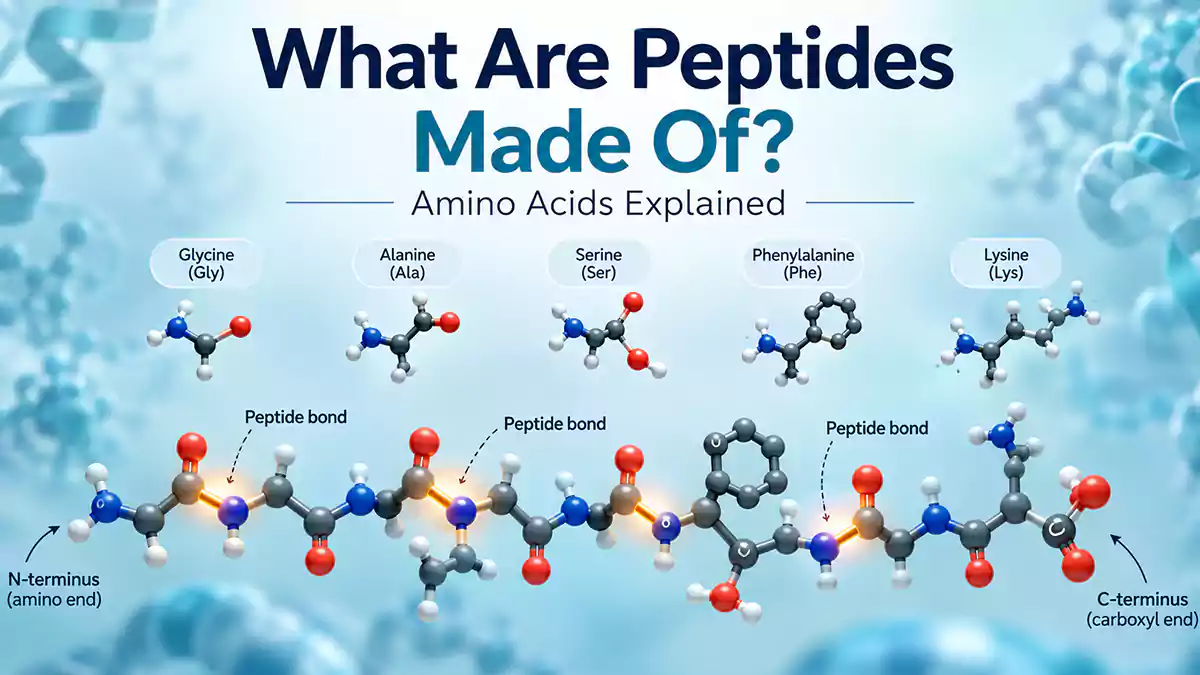
Peptides are made of amino acids connected by chemical bonds called peptide bonds. These amino acids form chains with specific chemical compositions and sequences. The type, number, and arrangement of amino acids influence a peptide’s molecular structure and chemical properties.
Understanding how these building blocks connect is fundamental to peptide chemistry, biochemistry, and scientific research.
What are the Building Blocks of Peptides?
Amino acids are the fundamental building blocks of peptides. They are organic molecules containing functional groups that allow them to connect through peptide bonds.
Each amino acid contributes to the chemical composition of a peptide. When two amino acids join, they form a dipeptide. Additional amino acids can be incorporated to create longer chains.
The resulting structure depends on three important factors:
- Amino acid identity: Which amino acids are present.
- Amino acid quantity: How many residues make up the chain.
- Amino acid sequence: The order in which those residues are connected.
For example, a peptide containing glycine, alanine, and serine has a different sequence from one containing the same amino acids in a different order.
This distinction is important because amino acid composition alone does not fully describe a peptide’s molecular identity.
What are Amino Acids?
Amino acids are organic compounds containing an amino functional group and a carboxyl functional group. The amino acids commonly incorporated into proteins are alpha-amino acids.
A typical alpha-amino acid contains four components attached to a central carbon atom, known as the alpha carbon.
| Component | Chemical representation | Primary role |
|---|---|---|
| Amino group | –NH₂ | Participates in peptide bond formation |
| Carboxyl group | –COOH | Participates in peptide bond formation |
| Hydrogen atom | –H | Attached to the alpha carbon |
| Side chain | –R | Determines distinctive chemical characteristics |
The simplified general structure is H₂N–CH(R)–COOH.
In aqueous solutions, amino acids often exist as zwitterions, with a positively charged amino group and a negatively charged carboxylate group. Their exact ionization state depends on conditions such as pH.
Why are Amino Acid Side Chains Important?
The side chain, also called the R-group, distinguishes one amino acid from another.
Different side chains can influence polarity, charge, hydrophobicity, and interactions with surrounding molecules.
For example:
- Glycine has a hydrogen atom as its side chain.
- Alanine contains a methyl group.
- Serine contains a hydroxyl-bearing side chain.
- Lysine has a side chain that is commonly positively charged near neutral pH.
- Aspartic acid has a side chain that is commonly negatively charged near neutral pH.
These chemical differences influence how peptide chains interact with water, other molecules, and their surrounding environment.
Are All Peptides Made From the Same 20 Amino Acids?
No. Although 20 standard amino acids are commonly used during protein synthesis, individual peptides contain only the amino acids specified by their sequences.
A peptide may contain several different amino acid types or repeated occurrences of the same amino acid.
The 20 standard proteinogenic amino acids are:
| Amino acid | Three-letter code | One-letter code |
|---|---|---|
| Alanine | Ala | A |
| Arginine | Arg | R |
| Asparagine | Asn | N |
| Aspartic acid | Asp | D |
| Cysteine | Cys | C |
| Glutamine | Gln | Q |
| Glutamic acid | Glu | E |
| Glycine | Gly | G |
| Histidine | His | H |
| Isoleucine | Ile | I |
| Leucine | Leu | L |
| Lysine | Lys | K |
| Methionine | Met | M |
| Phenylalanine | Phe | F |
| Proline | Pro | P |
| Serine | Ser | S |
| Threonine | Thr | T |
| Tryptophan | Trp | W |
| Tyrosine | Tyr | Y |
| Valine | Val | V |
Beyond these standard amino acids, certain organisms incorporate additional genetically encoded amino acids, including selenocysteine and pyrrolysine.
Peptides can also contain noncanonical amino acids or chemically modified residues, particularly in synthetic chemistry.
Therefore, the complete composition of a peptide cannot always be described using only the 20 standard amino acids.
How are Peptides Formed From Amino Acids?
Peptides form when amino acids become connected through peptide bonds.
A peptide bond is a covalent amide linkage between the carbonyl carbon of one amino acid and the nitrogen of another.
What Happens During Peptide Bond Formation?
In a simplified condensation reaction, the carboxyl group of one amino acid reacts with the amino group of another.
The net reaction releases one water molecule and forms a peptide bond.
Amino acid + Amino acid → Dipeptide + H₂O
The newly formed linkage has the structure –C(=O)–NH– in a typical peptide backbone.
Repeated bond formation creates longer peptide chains.
This condensation equation describes the overall chemical transformation. Inside cells, peptide synthesis occurs through a more complex, enzyme-assisted process involving ribosomes and activated aminoacyl-tRNAs.
Why is Water Released?
In the simplified condensation reaction, an –OH group from the carboxyl group and a hydrogen associated with the amino group are removed in the net transformation.
Together, these correspond to one molecule of water.
As the new carbon–nitrogen bond forms, the two amino acid units become connected.
For a conventional unmodified linear peptide formed from n free amino acids, there are n − 1 peptide bonds and the net condensation corresponds to the loss of n − 1 water molecules.
This relationship is useful when calculating the molecular composition of simple peptide chains.
What is an Amino Acid Residue?
An amino acid residue is the portion of an amino acid incorporated into a peptide chain.
The term residue distinguishes an amino acid unit within a peptide from an isolated, free amino acid molecule.
For example, a tripeptide contains three amino acid residues connected by two peptide bonds.
Scientists use residue terminology when describing peptide sequences, molecular structures, and chain positions.
Understanding Peptide Chain Structure
A typical linear peptide contains a repeating backbone composed of nitrogen, alpha-carbon, and carbonyl-carbon atoms.
Its side chains extend from the backbone and contribute to the molecule’s chemical characteristics.
N-Terminus and C-Terminus
A conventional linear peptide has two distinct ends:
N-terminus: The amino-terminal end of the chain.
C-terminus: The carboxyl-terminal end of the chain.
Peptide sequences are conventionally written from the N-terminus to the C-terminus.
This direction matters because reversing the order of amino acid residues generally produces a different molecule.
Why Does Amino Acid Sequence Matter?
Consider these two tripeptides:
- Gly–Ala–Ser
- Ser–Ala–Gly
Both contain one glycine, one alanine, and one serine residue.
However, their sequences differ because the residues appear in different positions.
Although these two examples have the same overall elemental composition in their unmodified forms, their molecular connectivity differs.
This demonstrates why both composition and sequence are essential for describing peptide identity.
What Elements are Peptides Made Of?
Most conventional peptides contain carbon, hydrogen, oxygen, and nitrogen.
Some also contain sulfur, particularly when methionine or cysteine residues are present.
Other elements may occur in peptides containing specialized amino acids or chemical modifications.
A peptide’s molecular formula depends on its exact sequence, residue composition, terminal groups, and modifications.
Consequently, there is no single molecular formula that represents every peptide.
How is Peptide Molecular Weight Determined?
For a conventional unmodified linear peptide, molecular mass can be estimated by adding the masses of its free amino acids and subtracting the mass of water corresponding to each peptide bond.
Peptide molecular mass = Sum of free amino acid molecular masses − (n − 1) × mass of H₂O
Here, n represents the number of amino acid residues.
This simplified calculation assumes a linear chain with standard unmodified termini. Terminal modifications, unusual residues, and other chemical additions require corresponding adjustments.
Molecular mass is an important characteristic in peptide identification and analytical research.
What is the Difference Between Peptides, Polypeptides, and Proteins?
Peptides, polypeptides, and proteins are closely related because they contain amino acid units joined by peptide bonds.
However, the terms are not completely interchangeable.
| Term | General description | Important distinction |
|---|---|---|
| Peptide | Relatively short amino acid chain | May contain standard or nonstandard residues |
| Polypeptide | An amino acid chain, often relatively long | Emphasizes the polymeric chain |
| Protein | One or more polypeptide chains forming a biological molecular entity | Typically associated with a defined structure and biological role |
Some educational sources use numerical residue counts to distinguish these categories. However, there is no universally applicable chain-length boundary that separates every peptide from every protein.
The terminology also depends on structural complexity, biological context, and established scientific usage.
Natural vs. Synthetic Peptides
Peptides may originate from biological systems or be produced through chemical synthesis.
Naturally Occurring Peptides
Naturally occurring peptides are generated through biological processes.
They may be produced by ribosomal synthesis, specialized biosynthetic pathways, or the processing of larger precursor proteins.
Their amino acid sequences and chemical modifications vary according to their biological origins.
Synthetic Peptides
Synthetic peptides are assembled using controlled chemical methods.
One widely used technique is solid-phase peptide synthesis, commonly abbreviated as SPPS.
In this approach, amino acid building blocks are incorporated sequentially through repeated chemical coupling steps.
Synthetic methods can produce selected sequences and may permit the incorporation of noncanonical residues or specific chemical modifications.
Importantly, the distinction between natural and synthetic describes how a peptide is produced, not necessarily a difference in its final molecular structure.
Why Does Peptide Composition Matter in Scientific Research?
Peptide composition provides essential information for identifying and characterizing a molecular structure.
Researchers examine several properties when studying peptides.
Amino acid sequence: Establishes the order of residues and helps define molecular identity.
Molecular mass: Supports analytical identification and comparison with expected composition.
Chemical modifications: Identify structural features that may not be represented by a basic amino acid sequence.
Purity: Describes the proportion of a target substance within an analyzed sample, according to the method and reporting basis used.
Structural characteristics: Help researchers understand molecular conformation and chemical interactions.
Analytical methods such as mass spectrometry and high-performance liquid chromatography are frequently used in peptide characterization.
These methods provide different types of information. For example, a chromatographic purity result alone does not establish a complete amino acid sequence.
Readers interested in the broader scientific context can also read what are research peptides?, which introduces research peptides and their role in laboratory studies.
Frequently Asked Questions
1. What are peptides primarily made of?
Peptides are primarily made of amino acid residues connected through covalent peptide bonds. Their exact composition depends on the identities and order of the residues.
2. Are peptides made of proteins?
No. Peptides and proteins both contain amino acid chains, but peptides are not simply pieces of protein in every case. Some peptides arise from protein processing, while others are synthesized independently.
3. What holds amino acids together in peptides?
Amino acids are connected by peptide bonds, which are covalent amide linkages. Hydrogen bonds may influence peptide conformation, but they are not the covalent bonds connecting adjacent residues in the backbone.
4. Do peptides contain all 20 amino acids?
No. A peptide contains the amino acid residues specified by its particular sequence. Many peptides contain only a small subset of the 20 standard amino acids.
5. Are amino acids and peptides the same thing?
No. Amino acids are individual molecular building blocks, while peptides contain two or more amino acid units joined through peptide bonds.
6. What is the difference between a dipeptide and a tripeptide?
A dipeptide contains two amino acid residues connected by one peptide bond. A tripeptide contains three residues connected by two peptide bonds.
7. Can peptides contain nonstandard amino acids?
Yes. Some peptides contain noncanonical amino acids, genetically encoded specialized residues, or chemically modified amino acid units.
8. Are peptides made of DNA?
No. Peptides are composed of amino acids, whereas DNA is composed of nucleotides. DNA can encode information used during the biological synthesis of many peptides and proteins, but it is not the chemical building material of a peptide.
9. Can two peptides have the same amino acids but different structures?
Yes. Two peptides can contain the same amino acid types and quantities but have different sequences. Their distinct connectivity can produce different molecular properties.
10. Do all peptides have the same molecular weight?
No. Molecular weight varies with amino acid composition, sequence length, and chemical modifications. Different peptides may also have the same nominal or exact mass without being structurally identical.
Conclusion
Peptides are made of amino acids joined by peptide bonds. Their molecular identity depends on the types, numbers, and sequences of amino acid residues, along with any chemical modifications.
Understanding amino acid structure, peptide bond formation, and sequence organization provides a foundation for studying peptide chemistry.