
- udies
- Oxidative stress mechanism investigations
- Glutathione peroxidase activity research
- Glutathione reductase enzyme studies
- Glutathione S-transferase interaction analysis
- Reduced and oxidized glutathione characterization
- Comparative biochemical research
- Analytical method development
- Glutathione stability and oxidation investigations
Storage and Handling
Store Glutathione according to the conditions specified on the product label, Certificate of Analysis, or accompanying technical documentation. Protect the material from excessive heat, moisture, direct light, and unnecessary environmental exposure. Storage requirements may vary depending on the material’s oxidation state, physical form, and formulation characteristics.
For powdered or lyophilized Glutathione, maintain the container securely sealed until required for controlled laboratory preparation. Once prepared in solution, stability may depend on solvent composition, concentration, pH, temperature, dissolved oxygen, container material, and storage duration. Reduced Glutathione may oxidize under certain experimental conditions, so appropriate stability assessment and analytical verification are important to maintain material integrity.
Avoid repeated temperature fluctuations and prolonged environmental exposure where possible. Use appropriate laboratory handling procedures and maintain accurate records of preparation dates, storage conditions, oxidation state, lot numbers, and analytical use. Researchers should follow documented procedures to support material traceability, assess chemical stability, and ensure consistency throughout experimental investigations.
Product Specifications
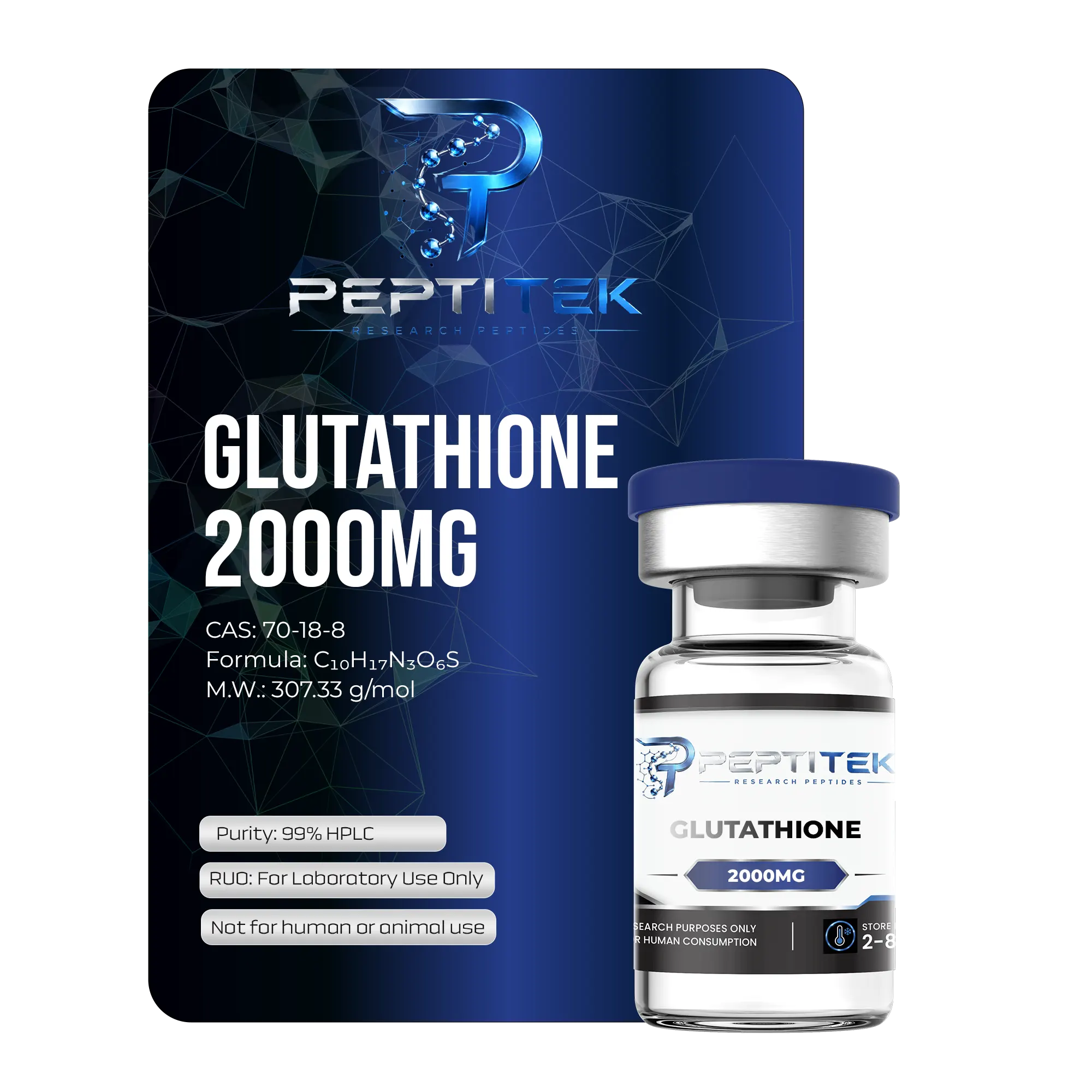
Product Name: Glutathione
Alternative Names: Reduced Glutathione, L-Glutathione, GSH, γ-L-Glutamyl-L-cysteinyl-glycine
Product Category: Naturally occurring tripeptide
Peptide Sequence: γ-L-Glu-L-Cys-Gly
Peptide Length: 3 amino acid residues
CAS Number: 70-18-8 (Reduced Glutathione)
Molecular Formula: C₁₀H₁₇N₃O₆S (reduced form)
Molecular Weight: Approximately 307.32 g/mol (reduced form)
Structural Modification: Gamma-glutamyl linkage between glutamic acid and cysteine; free sulfhydryl group on the cysteine residue
Material Form: Verify through lot-specific documentation
Oxidation State: Confirm reduced or oxidized form through product-specific documentation
Salt Form: Verify through product-specific documentation
Appearance: May be supplied as a white or off-white powder or lyophilized research material; confirm lot-specific documentation
Purity: Refer to lot-specific Certificate of Analysis
Container Type: Sealed research vial or product-specific container
Testing Documentation: Lot-specific analytical records, where provided
Intended Setting: Controlled laboratory research
Use Classification: Research use only
Human or Veterinary Use: Prohibited
Quality Assurance
Each lot of Glutathione should include appropriate product-specific documentation, where available. Analytical records may include identity confirmation, purity assessment, chromatographic analysis, mass-spectrometric characterization, molecular specifications, oxidation state evaluation, batch identification, and recommended storage conditions. These records support chemical characterization, material traceability, and analytical consistency within controlled laboratory research environments.
Researchers should verify that the stated molecular formula, molecular weight, peptide identity, oxidation state, purity, and lot number correspond with the Certificate of Analysis before beginning experimental work. Where appropriate, analytical documentation should distinguish Reduced Glutathione (GSH) from Oxidized Glutathione (GSSG), since the two forms have different molecular structures and redox characteristics that may influence experimental interpretation.
Because molecular specifications and stability characteristics may differ between reduced, oxidized, salt, or hydrated forms, lot-specific documentation should serve as the primary reference for analytical calculations, material identification, biochemical characterization, and experimental recordkeeping. Appropriate verification procedures support reproducibility and consistency when evaluating Glutathione under defined laboratory conditions.
Research Use Disclaimer
For laboratory research use only. Not for human or veterinary use. Not intended for injection, administration, diagnosis, treatment, cure, or prevention of any disease. Do not use this research product as a food, drug, cosmetic, dietary supplement, or household product.

Reviews
There are no reviews yet.